Units:
Drive side:
| Headlight | Wall target height | Angle |
|---|---|---|
| Left | - | - |
| Right | - | - |
| Headlight | Wall target height | Angle |
|---|---|---|
| Left | - | - |
| Right | - | - |
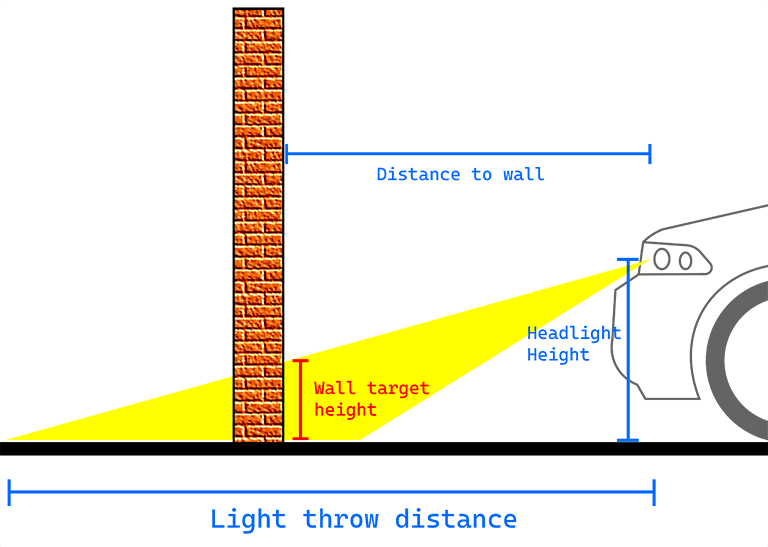
To use this calculator, park your car on a level surface facing a flat wall, then measure two things:
Enter these measurements into the calculator. You also need to decide on your desired light throw distance—which is how far ahead of the car the beam should illuminate the road. We limit this value to safe, legal ranges to prevent blinding other drivers. We recommend leaving it at the default setting.
Once entered, the calculator will compute the precise wall target height. You can then adjust your headlight vertical aiming screws so the top of the beam pattern matches these target heights on the wall.
Here is the beam alignment pattern you want to achieve:
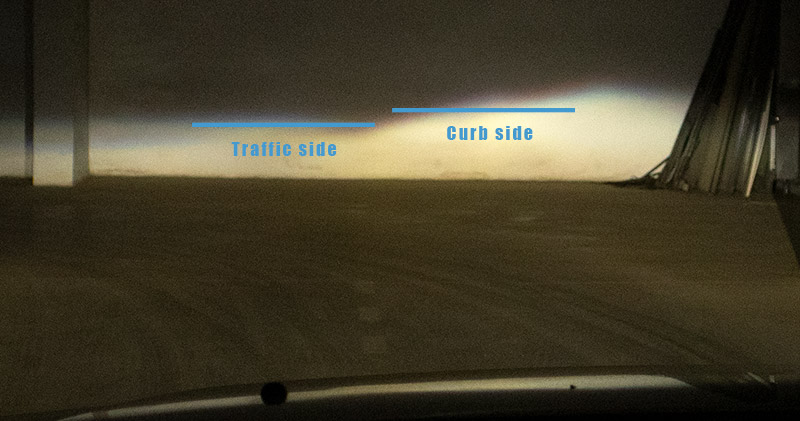
Correctly aimed headlights maximize your nighttime visibility and prevent dangerous glare for oncoming drivers. If your headlights point too high, they will blind other drivers and disperse the light beam, leading to poorer visibility on the road. If they point too low, your field of view is drastically shortened, preventing you from seeing road hazards in time.
While vehicles come aligned from the factory, factors like worn suspension components, carrying heavy cargo, or changing a bulb can alter the alignment over time. Additionally, many modern cars have headlights factory-adjusted too low, reducing safe stopping sight distance.
To prevent blinding oncoming drivers, the headlight on the traffic-facing side of the lane is always adjusted to project slightly lower than the curbside headlight.
For Right-Hand Drive (RHD) traffic conditions, the right headlight is adjusted lower. Conversely, Left-Hand Drive (LHD) vehicles have the left headlight adjusted lower to avoid oncoming traffic. Our calculator automatically applies this offset, reducing the throw distance of the traffic-side headlight by 5 meters (15 feet).
Most modern headlight assemblies have two adjustments: a vertical screw/bolt and a horizontal screw/bolt. These are usually located on the back or top of the headlight assembly housing, accessible by opening the hood (bonnet). Some cars require accessing them through access panels in the wheel wells. Consult your car's owner's manual for their exact placement, and make small, incremental turns while watching the beam on the wall.
While adjusting vertical alignment against a wall is a straightforward DIY task, we encourage visiting a professional mechanic if you want absolute precision. Our calculator helps you align vertical height, but professional shops use optical alignment machines that also calibrate horizontal alignment and beam intensity for 100% accuracy.
Standard LED headlights can be manually adjusted using their mechanical screws. However, you should **never** attempt to adjust adaptive Matrix LED headlights manually. Matrix headlights rely on sophisticated algorithms, steering angle sensors, and front cameras to segment the beam around traffic. If they are misaligned, they must be calibrated electronically by a dealership or certified service center.